Social Security’s Trust Fund Runs Dry in 2032: What Actually Happens

Updated: Sep 7
The Social Security trustees now project that the trust fund will be depleted in 2032, one year earlier than their previous estimate. The headlines have left a lot of people thinking the program is going away, but it isn’t. If Congress does nothing, payroll taxes would continue funding most benefits, but payments would be cut by about 22%. That’s the worst-case scenario, not the most likely one. Will breaks down what Congress could do, from changing the wage cap or tax rate to means testing and raising the full retirement age.
Then we turn to interest rates. Longer-term rates are nearing 20-year highs, while expectations for short-term rates have shifted from cuts this year to two Fed hikes. With the 10-year Treasury back at 4.8% and mortgages near 7%, housing is in a freeze. This isn’t just a U.S. debt story, either. Rates are climbing in the UK, Japan, and across Europe. We wrap up with five-year bond returns, what CrowdStrike’s run tells us about misleading market narratives, and the Atlanta Fed’s latest GDPNow forecast for Q3.
Video Recap
Prefer to read instead of watch? Here's the full breakdown
The 2032 Date
The Social Security trustees moved the trust fund depletion date from 2033 to 2032 in their June report, and the headlines that followed have left a lot of people believing the program itself is ending. It is not.
If Congress does nothing at all, here is the mechanic. When the trust fund is exhausted, everyone currently collecting takes a 22% cut to their benefit. Anyone who has not started yet sees their estimate cut by the same 22%. The program keeps running, because payroll taxes are still coming in every pay period and those taxes fund the majority of what goes out.
That is the do-nothing scenario, and it is the worst case rather than the likely one. Congress has been here before, in 1983, and it acted. It will almost certainly act again. It will also almost certainly wait until the house is on fire, because this is not a subject anyone in Washington wants to campaign on.
What Congress Could Change
Four proposals come up most often, and the eventual fix will probably be some combination of them rather than any one on its own.
Raise or eliminate the earnings cap. Social Security taxes total 12.4% of income, split between employer and employee, with business owners paying both halves. Right now that tax stops at $184,500 of income. The cap exists because benefits are capped too: Elon Musk and Bill Gates are not collecting $15,000 a month. Raising it is plausible. Eliminating it is not.
Raise the tax rate. Take the 12.4% up to 14% or 16%.
Raise the full retirement age. Currently 67 for anyone born in 1960 or later.
Means test. Reduce benefits for retirees above some income threshold. On its own this does not come close to closing the gap.
The full retirement age is where we would look first. When Social Security was created in the 1930s, the retirement age was 65 and life expectancy was also about 65. You made it to 65, and if you were still around, you collected. Life expectancy is now around 80. The full retirement age has moved up by two years.
Will is 48, and a lot of his friends are asking whether Social Security will even be there for them. Most of them would take a full retirement age of 69 or 70 without a complaint if it meant the program was actually stable when they got there. That trade should have been made a long time ago.
The Payout Curve
Social Security paid out $1.654 trillion over the last year. The shape of that line matters more than the level.
For decades the number climbed slowly and steadily. Over roughly the last ten years it has bent sharply upward, and the reason is demographic rather than political: the baby boomers are collecting.
The same math shows up in the worker-to-beneficiary ratio. There are now 2.9 people working for every one person receiving benefits. Fifty or sixty years ago that number was five or six, and it was higher than that before. No adjustment to the tax rate or the cap changes the underlying arithmetic of that ratio.

For anyone within a decade of claiming, none of this changes the decision in front of you today. What it changes is how much weight a 2032 benefit estimate deserves while Congress still has six years to rewrite it.
Oil, and the Turn in Short-Term Rates
A couple of months ago oil had dropped to $70 a barrel from near $100, and we were hopeful that the Middle East conflict was winding down and gas prices were headed lower. That has not happened. Oil is back at $90.

Short-term rates have followed. The 2-year Treasury fell for most of a year and bottomed at 3.38% in February. The conflict started, and it has climbed most of the way since, hitting 4.34% last week.

At the Fed's Jackson Hole symposium, new chair Kevin Warsh made it clear he is leaning toward hikes this year. A year ago the market expected two cuts by now. It now expects two hikes. That is a meaningful change for the parts of the economy that borrow short.
On inflation itself, we are watching the pace rather than the level. Prices are still far above where they sat five or six years ago and that is not coming back. What would worry us is another spike. CPI is at 3.30%, PCE at 3.70%, and PPI at 4.70%. Set those against the 2022 peaks of 9.00%, 7.12%, and 11.66% and it is a different universe. The market is not pricing a repeat.

The 10-Year and the Housing Freeze
Longer-term rates are not driven much by what the Fed does. They respond to the pace of economic growth, to inflation, and to global forces. The 10-year Treasury is the one to watch, because it sets mortgage rates and it sets what companies pay to borrow.
We have been flagging the 4.8% level for several years now. Rates have reached it three or four times and pulled back every time, with one exception: about a week in 2023 when we stayed above it and touched 5%. The 10-year is at 4.79% today, right back at the line.

The consequence is already visible in housing. A 30-year fixed mortgage is at nearly 7%, and housing is in a freeze. Home Depot used that exact word on its earnings call two weeks ago. We do not want to see the 10-year push above 5% and stay there, because that is the level where the damage starts reaching the broader economy and the stock market.
A Global Move, Not Just a Debt Story
Some people are attributing the rise entirely to the U.S. crossing $40 trillion in debt. That is part of it, and we said as much a couple of weeks ago. But it is not the whole explanation, and there are two reasons to think so.
The first is that the economy is growing at a faster clip, with data center construction pulling industrials and tech along with it. The second is that this is happening everywhere.
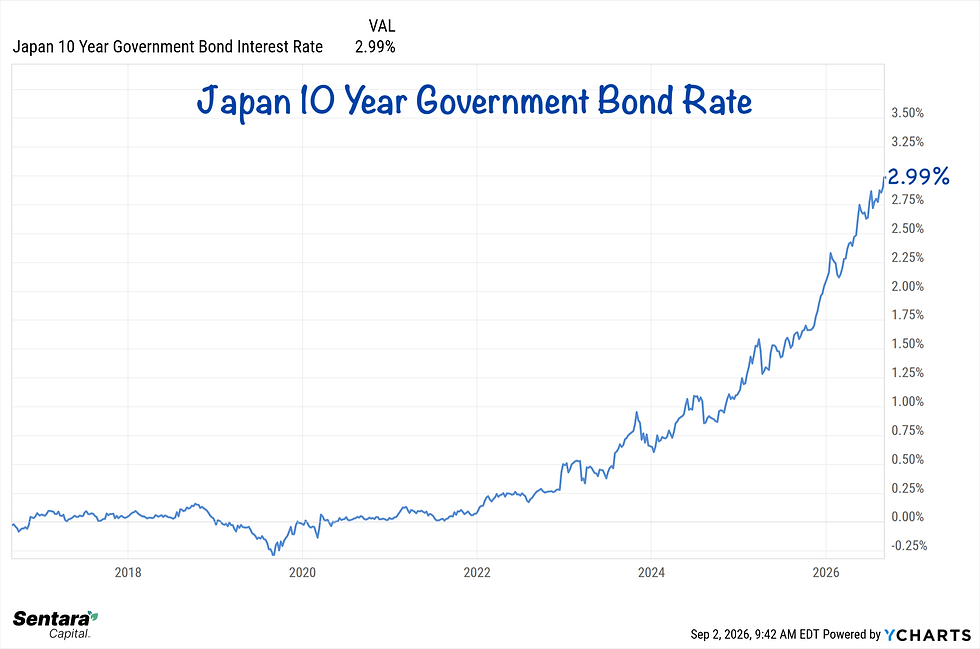
The UK 10-year gilt is at 5.14%, the highest in 20 years. Japan's 10-year just hit 2.99%, and that rate was negative six years ago. Germany, France, and Italy are all moving the same direction. Rates are rising together, which is not what a story about one country's balance sheet looks like.

Now for Rapid Fire
Five years of bond returns have been ugly. The Barclays Aggregate Bond Index, the bond market's equivalent of the S&P 500, is down 1.73% over five years on a total return basis, which includes the interest you were paid. The bond market has never had a losing five-year stretch in its history before this one, and 2022 did most of the damage at nearly 13% down. Long-term Treasuries were far worse: the 20-year-plus TLT is down 34.42%. We have held no long-term bond funds in client portfolios over that period. Rising rates are the cause, and the flip side is that money invested today gets paid a much better rate than it did five years ago.

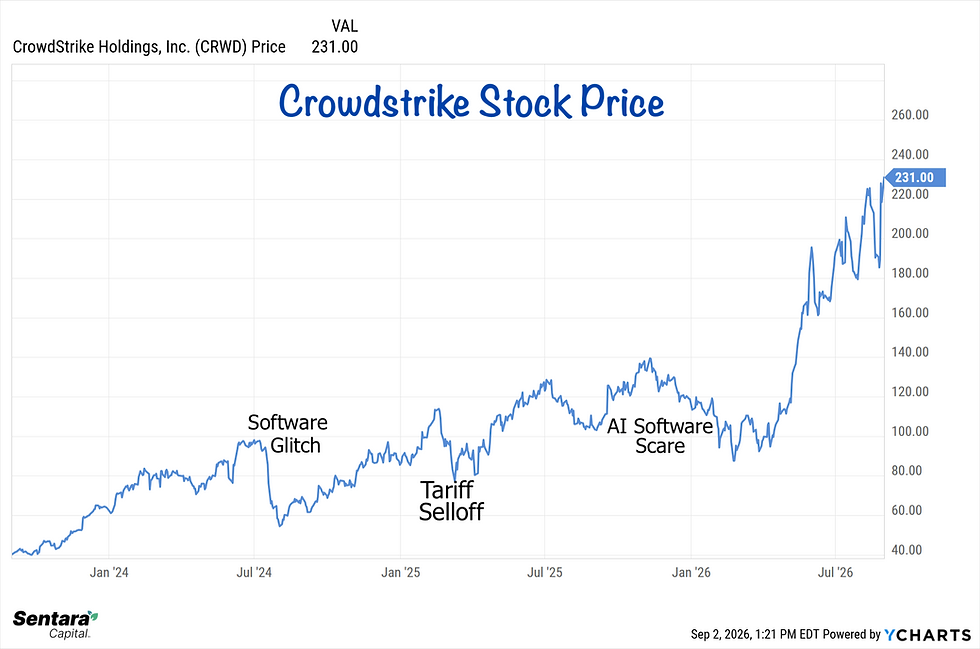
CrowdStrike shows how wrong a market narrative can be. The stock has gone from $40 to $231 over three years, and it survived three separate stories about its demise. In the summer of 2024 a software glitch took down networks worldwide and the stock fell almost 50% in two and a half weeks. CEO George Kurtz worked through essentially every major client in the months that followed, and the stock made a new high. The spring 2025 tariff selloff took more than 30% off it despite tariffs having little to do with the business. Then it peaked in November 2025 and sold off nearly 40% on the narrative that AI would gut cybersecurity companies. We did the research and concluded that narrative was wrong. Two earnings reports later, the stock has almost tripled in five months.
Third quarter growth is tracking at 4.8%. The Atlanta Fed's GDPNow model has Q3 at 4.8%, up from 4% when we looked a month ago. For reference, 2% is considered a healthy growth rate. Tech and AI are part of it, but financials and industrials are contributing, and as we have covered in the last couple of updates, smaller and midsize companies are seeing their earnings take off.

Have questions about what this means for you?
It’s one thing to follow the markets. It’s another to know whether anything needs to change in your own portfolio. At Sentara Capital, we do that work for you, keeping your goals at the center of every decision. If you’d like to talk about your investments or retirement plan, we’d be glad to hear from you.
Contact Us at (770) 509-5305 to Begin Your Journey
FAQ: Social Security's 2032 Trust Fund Date
Will Social Security run out of money in 2032?
The trust fund is projected to be depleted in 2032, which is not the same thing as the program running out of money. Payroll taxes continue flowing in from every working American and would fund roughly 78% of scheduled benefits indefinitely without any change in the law. The trust fund is the reserve that covers the gap between what comes in and what goes out.
Has Congress ever waited this long to act?
Yes, and recently enough to be instructive. In 1983 the trust fund was within a few months of depletion before Congress passed a reform package, and that package bought another 50 to 75 years of solvency. The pattern is that nothing happens until the deadline is close enough to be unavoidable.
Does raising the full retirement age count as a benefit cut?
In practical terms, yes. Moving the full retirement age from 67 to 69 means a worker either claims two years later for the same monthly amount or claims at the same age for a permanently reduced one. It is a reduction delivered as a delay, which is part of why it tends to be more politically survivable than an explicit cut.
Why are mortgage rates near 7% if the Fed might be raising rates only now?
The Fed controls overnight rates, and mortgages track the 10-year Treasury instead. That longer-term rate responds to economic growth, inflation expectations, and global demand for bonds rather than to Fed policy directly. It is why the 10-year and the 30-year mortgage can move well ahead of anything the Fed announces.
Why do bond funds lose money when interest rates go up?
Bond prices and interest rates move in opposite directions. When new bonds are issued at higher rates, existing bonds paying less become worth less, and a fund holding them marks down. The longer the maturity, the sharper the effect, which is why 20-year-plus Treasuries fell so much further than the broad bond index over the same five years.
Click for Full Transcript
With recent headlines that the Social Security trust fund is going to be running out of money in 2032, it has a lot of people asking, "What does that mean for my Social Security?" Then longer-term interest rates are nearing 20-year highs. We're going to tell you why that matters. We're also going to look at CrowdStrike and the lesson in how wrong media narratives can be about certain parts of the market. We have that and more. Let's dive into it.
I was recently invited onto SiriusXM's show On The Move with Dan Ronan to talk about Social Security. And one of the key topics is something I've been hearing about a lot. This was in June. The trustees' 2026 report on Social Security moved the date that the Social Security trust fund runs out of money from 2033 to 2032. And of course, a lot of headlines have been out there since. Social Security is going broke. Social Security's running out of money. And a lot of people want to know, well, what exactly does that mean? So we're here to kind of set the record straight.
Let's start out by saying if nothing is done at all, what would occur is when the trust fund runs out, everybody currently would be cut by 22%. So if you are receiving Social Security, you'd have a 22% cut to your benefits. Those people who haven't started, your estimates would also be cut by 22%. The program would still continue, because currently there are taxes that are paid into the system on an ongoing basis, payroll taxes, and those would fund people continuing to receive their benefits into the future.
Now, that is if nothing is done. We know that it's very likely that Congress will do something, but they literally like to wait until the house is on fire. They don't like to talk about this. We have an example in 1983, when we basically got within a few months of the trust fund running out of money and at the last minute Congress came in and made a whole bunch of changes that extended it for another 50 to 75 years. And now we're in the situation where we're getting close to that again.
So what could Congress do? There are a number of proposals out there, and it's impossible for us to know what will end up being changed, but here are a couple of the suggestions. One is to raise or eliminate the current earnings cap subject to Social Security taxes. Right now the employer and the employee split this tax. It comes up to 12.4% of your income. If you are a business owner, you pay both sides. But right now $184,500 is the cap, meaning if you make above that, you don't pay any more. And the reason for that is there are limits on how much someone can get in their Social Security benefit. In other words, an Elon Musk or a Bill Gates, they're not getting 10 or 15 or $20,000 a month. They are capped. That's why there is this cap. But there are suggestions to raise it, and even a few people say let's eliminate it altogether. Very unlikely that that's going to happen.
Another option is to raise the tax rate. Instead of 12.4%, why don't we take it up to 14% or 16%?
The third option here, raising the full retirement age. This to me is where they should look. The full retirement age is 67 for anyone born 1960 or later. When Social Security was created back in the 1930s, at that time the retirement age was 65. And guess what? 65 was the life expectancy at that time. So it was basically, you live to 65, and if somehow you made it past, now you're getting Social Security. Well, life expectancy is around 80 now, but that full retirement age has only gone up by two years. I'm 48, and I could tell you a lot of my friends are saying, is Social Security even going to be around? They'd happily have their full retirement age go to 69 or 70 if they knew it would make the program steadier and it could be there for them. That is a no-brainer. It should have been done a long time ago.
Another option out there is reducing benefits for higher income retirees. So kind of a means test that would say, listen, if your income's over some amount, then your level goes down. That alone is not going to get it done. What will probably happen is some combination of those examples and maybe some other things also.
The bottom line is Congress is not going to let Social Security go away or have significant cuts for those who rely on it. We think something will be done, but it's just not likely to happen until the last minute.
Now, one other point I want to make about Social Security is take a look at how much the government's paying out over the last year in Social Security. You can see that is $1.65 trillion. And what's notable to me here is if you look over time, this number was kind of slowly and steadily going up, and then in the last 10 years or so it has gone up much quicker. And the main reason for that is baby boomers. There are a lot more people receiving Social Security.
Another point that doesn't have anything to do with this but is important is that right now there's 2.9 people working for every one person receiving Social Security. This number was five or six 50 or 60 years ago, and even higher before then. So there are some issues that certainly are going to have to be addressed in the future to put the program on much more solid footing.
So a couple months ago we were excited here because oil had dropped to $70 a barrel from up near $100 a barrel, and we were thinking hopefully the conflict in the Middle East would be over, gas prices come down. That has obviously not happened. In fact, oil has risen and is back at $90 a barrel. Not good news for people at the pump.
And another impact from all of this is that interest rates have started to go up. And we're talking right now about short-term interest rates. You can see a 2-year Treasury, which had been going down for almost a year, hit 3.4% in February of this year. The conflict starts, and this has been going up most of the way ever since and just hit 4.34% last week.
We had a big Fed symposium in Jackson Hole, Wyoming. The Fed chair Kevin Warsh, he's new, came out and made it clear he is leaning towards doing rate hikes this year. If you go back a year, there was expected to be a couple rate cuts by the end of this year. Now two rate hikes are expected. That's not great news for certain parts of the economy.
Now, I do want to address inflation for a second, because we know that prices are still much higher than they were five, six years ago, but what we're concerned about is that the pace of price increases doesn't end up spiking again like it did. Look at the inflation rate. This is measuring the CPI, the PCE and PPI. These are just different parts of prices being measured, business or consumer. Notice even though inflation has gone up a little on the right side, compare that to where the inflation rates were five years ago. We're not even in the same world, the same universe here. This is good news. The market is not expecting prices to go up like they did a few years ago.
All right, now let's switch over and talk about longer-term rates that aren't impacted very much by what the Fed's going to do. What matters more here is what's the rate of economic growth, what's happening with inflation. There are also global factors that are involved. But I want to highlight this because the 10-year Treasury bond is important. This is what determines mortgage rates by and large, and also when companies go and they need to borrow, what kind of rates they're going to pay.
We have been highlighting for several years the 4.8% level here, because we've gotten up to this level three or four times and every time rates started to come back down. The exception was in 2023, we had about one week where we stayed above that level, got up to 5%. Notice we are back at that 4.8% rate again. And we're going to be watching this very carefully, because again, this is really hurting housing. I looked today, a 30-year fixed mortgage rate is at nearly 7%. Housing is in a freeze. When we see that, we heard that from Home Depot two weeks ago. They literally used the word freeze. So this is something that we're paying very close attention to in the weeks and months to come. We don't want to see the 10-year Treasury rate go up to 5% and above it and stay there. That will start to really hurt the stock market and the economy.
Now, one other thing that I want to mention here, because there have been some people that say, look, this is mainly because we just hit $40 trillion in debt. And so that's a concern, and there's no doubt that that plays some part here. But also what's playing a part is the economy is moving up at a faster clip. Now, y'all know there's a lot of data centers being built. So industrials are doing well, tech firms are doing well. But it isn't just an issue having to do with the $40 trillion. And how do we know that? Because when we're looking around the world, rates are at multi-year highs there too. And I'm just going to pick a couple countries. In the UK, 5.14% is their rate. I went back 20 years. This is the highest it's been there in 20 years. Japan just hit 3%. This was in the negatives six years ago. You can see that has gone straight up. And it's this way in Germany, in France, in Italy, kind of all over the globe. Interest rates are going up together. It's going to bear very close watching.
All right, now it is time for rapid fire. And this is where we go over a couple key charts we think you need to know about. We're going to start off looking at bonds. This goes along with interest rates, because rates have been going up. That has not been good news for bond returns. Now, in the future that's positive, because you can get higher rates. But over the last five years, take a look in purple. That is the Barclays Aggregate Bond Index. It's the equivalent of the S&P 500 of the bond market. And this is if you had bought this fund and invested in that five years ago and not done anything else, you are down nearly 2%, and this is total return. It includes the price move and the interest you've been getting paid. So you have lost money. The bond market has never had in its history a period of time for five years where it has been down. And 2022 was the biggest kicker for this. It was down almost 13%. But this is a big part of our job, is managing the bond portfolio for clients.
One other thing, the long-term Treasuries, 20-year plus, the TLT is down. You can see there, 34%, a horrible rate of return. We have had no long-term bond funds in client portfolios over the last five years, because we say, look, if we can lose 30, 40, 50% here, we'd rather have some fund buying SpaceX or a stock that's in the news and that clients can follow. Not really, but the point is we don't want this anywhere near our conservative client portfolios.
All right, next up is CrowdStrike, a stock that I want to highlight. Over the last three years it has done very, very well, gone from $40 up to $230. An amazing, amazing run. But here's what's pretty notable. In the summer of '24 they had a software glitch that took down a lot of computer networks all over the country and parts of the world for a few hours, and for some companies it took even longer than that. The stock then proceeded to drop almost 50% in two and a half weeks, and a lot of people said they are done. But their CEO, George Kurtz, did an amazing job of crisis control, reached out to pretty much every key client in the days and months to come. And you can see the stock raced back higher, hit a new all-time high.
Then in the spring of '25, the tariff selloff. This thing dropped over 30%, but they weren't really impacted by it. So again, this stock races higher. And then it peaked November of 2025 and began a nearly 40% selloff that bottomed in the spring during the Iran conflict. And it fell because of a narrative, and a lot of software stocks went down. We've talked about this, that AI was going to significantly damage these cybersecurity companies. We did a lot of research and came and said we don't believe that's going to be the case. And lo and behold, CrowdStrike has since had two earnings reports where they knocked the cover off the ball. And that is what has driven the stock up. You can see there it is almost tripled in the last five months, as the market realized this narrative that AI was going to damage them was not right. This is not the only time media narratives about certain parts of the market have been way, way off, and it's a part of what we do in this channel is explain this to folks.
All right, the last chart real quick and we'll get you out of here is taking a look at the GDP forecast for the third quarter. The Atlanta Fed has this model, we talk about GDPNow, and it just hit 4.8% expected. We looked at this about a month ago and 4% was the number. Why this matters is 2% is what's viewed as a pretty good growth rate for the economy. 4.8 is tremendous. One of the things driving this, of course, is tech and AI, but the financial part of the market, the industrials part of the market, and a lot else are also taking part. And as we've highlighted in the last couple of videos, smaller and midsize companies now are having their earnings and their businesses really take off. That is something we really like to see.
Okay, so the key takeaways are that although the Social Security trust fund is possibly going to be running out of money by 2032, it doesn't mean Social Security is going to go away. But what it does mean is that we are likely not going to know what Congress is going to do till the very last second. And then on interest rates, they are near 20-year highs and the Fed is now expected to do two rate hikes over the next couple months. We will be closely watching that.
Listen, if you are new to Sentara Capital, please go to our reworked website and our brand new retirement and investing pages, and then you can head over to contact. If you don't have an advisor who cares about the investment and planning both passionately, and if you're not getting market updates like what we do, we'd love to talk to you. Well, thanks for watching, and take care.


Comments